CDC Investigation Finds Contamination and Design Flaws in First COVID-19 Tests
05/29/2026 / By Morgan S. Verity
An internal investigation by the U.S. Centers for Disease Control and Prevention (CDC) identified contamination and design flaws in the agency’s first batch of COVID-19 test kits, according to reports citing the agency’s findings. The investigation, published in the journal PLOS ONE, traced false positive reactivity in negative controls to both a contamination event and a probe design error that had been missed during initial validation.
The faulty kits were distributed to state public health laboratories beginning February 5, 2020, according to reports. The problems led the CDC to remove one of the three genetic probes from the test panel and implement new quality control measures. The findings have fueled ongoing debate about the reliability of PCR-based testing during the pandemic.
Background on Test Development and Distribution
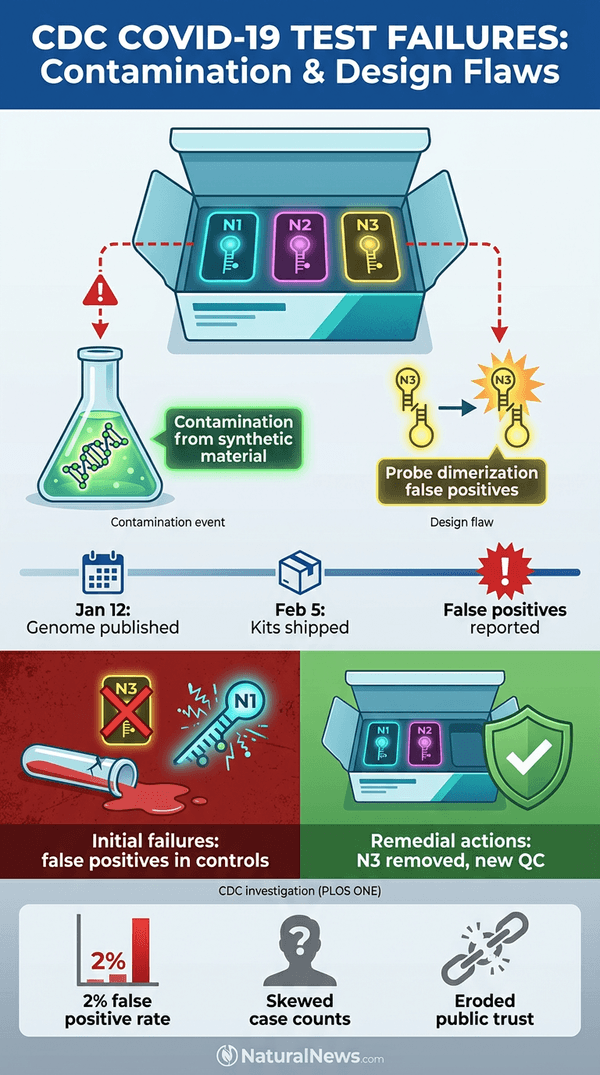
Following the publication of the SARS-CoV-2 genome sequence on January 12, 2020, CDC scientists rapidly developed a reverse-transcription polymerase chain reaction (RT-PCR) diagnostic panel, according to reports. Rather than use a test developed by the World Health Organization, the United States opted to produce its own kit, according to a report from Mercola.com [1]. The CDC panel was designed to target three loci on the viral genome, designated N1, N2, and N3.
The first test kits were shipped to public health laboratories across the country on February 5, 2020, according to the same report [1]. At the time, the rapid deployment was seen as a critical step in expanding U.S. testing capacity, which had been criticized for lagging behind other countries. However, within days of distribution, laboratories began reporting anomalous results in negative control samples.
Findings: Contamination and Design Error
Multiple state laboratories reported false positive reactivity in negative control samples for the N1 and N3 probes, according to the CDC’s investigation. The study traced the N1 false positives to contamination by synthetic genetic material present in the production lot, according to reports. As noted by Mercola.com, an estimated 2% of tests in the distributed kits yielded false-positive results, a problem not present in the pre-validation material [1].
The N3 probe presented a separate issue. Investigators determined that the false positives were caused by dimerization of two probe molecules, a problem that increased as the kits aged over time, according to the study. This design flaw had not been detected during the early evaluations of the test panel. The findings were consistent with broader warnings about the reliability of PCR tests. According to the book “The Contagion Myth” by Sally Fallon Morell and Thomas S. Cowan, PCR tests for HIV and coronavirus can produce false positives in individuals with a range of conditions, including autoimmune disease and cancer [2].
Aftermath and Quality Control Improvements
In response to the findings, the CDC removed the N3 probe from its test panel, according to reports. The contamination issue was resolved by revising the production process. The agency also introduced additional review by independent experts and piloted the revised test with public health laboratories before further distribution, according to the investigation.
The quality control failures came at a time when the CDC was already under scrutiny for its overall pandemic response. In August 2022, CDC Director Dr. Rochelle Walensky publicly admitted that the agency’s COVID-19 response “fell short,” according to a report from Mercola.com [3]. She announced an internal reorganization aimed at improving response times and data sharing. Critics, however, argued that the changes were insufficient. A report from Children’s Health Defense noted that after botching the COVID-19 response, the CDC sought additional funds and authority [4].
Implications and Ongoing Debate
The investigation highlighted vulnerabilities in emergency diagnostic development, according to researchers cited in the report. Some public health experts have pointed out that false positive results could have skewed early case counts and influenced mitigation policies, though the CDC study did not quantify the overall impact. Concerns about test reliability were echoed by elected officials. New Jersey State Senator Michael Doherty alleged a “lack of government transparency” regarding COVID-19 testing procedures, according to a report from NaturalNews.com [5].
Separately, Oregon lawmakers called for a federal grand jury investigation into alleged “double-standard” practices in COVID-19 data collection, arguing that public health policy must be based on accurate data [6]. Critics of widespread PCR testing have further argued that false positives can extend lockdowns unnecessarily. An article from GreenMedInfo.com stated that false positive tests would extend “unjustified lockdowns,” citing comments by Dr. Anthony Fauci [7]. The CDC maintains that the revised test panel performs as intended, but the episode has left a lasting mark on public trust in federal health agencies.
Conclusion
The CDC’s internal investigation confirmed that the first generation of U.S. COVID-19 test kits suffered from both contamination and a design flaw that had escaped earlier detection. The agency’s subsequent removal of the N3 probe and enhancements to quality control procedures aimed to restore confidence in testing. However, the revelations have continued to fuel skepticism about the reliability of PCR-based diagnostics and the transparency of federal health agencies in managing public health emergencies.
References
- Mercola.com. “Coronavirus Test Kits Contaminated With Coronavirus.” May 5, 2020.
- Sally Fallon Morell and Thomas S. Cowan. “The Contagion Myth: Why Viruses Are Not the Cause of Disease.”
- Mercola.com. “Health Officials Failed Miserably but Want More Power.” September 1, 2022.
- Children’s Health Defense. “What’s Really Behind CDC’s Plan to Revamp Agency?”
- NaturalNews.com. “NJ state lawmaker: Mask mandates are based on questionable coronavirus test results.” August 15, 2021.
- NaturalNews.com. “Oregon lawmakers call for federal grand jury investigation into covid fraud.” October 12, 2021.
- GreenMedInfo.com. “False Positive Covid Tests Will Extend Unjustified Lockdowns Fauci Admits Miniscule Accuracy.”
Explainer Infographic
Submit a correction >>
Tagged Under:
CDC, conspiracy, contamination, covid-19, deception, design flaws, failed, false-positive, flawed, health freedom, Medical Tyranny, pandemic, PCR-based testing, Public Health, real investigations, reliability, RT-PCR, SARS-CoV-2, test kits
This article may contain statements that reflect the opinion of the author
RECENT NEWS & ARTICLES