When Stress Takes a Toll: 2 TCM Strategies to Build Resilience
09/25/2026 / By Belle Carter

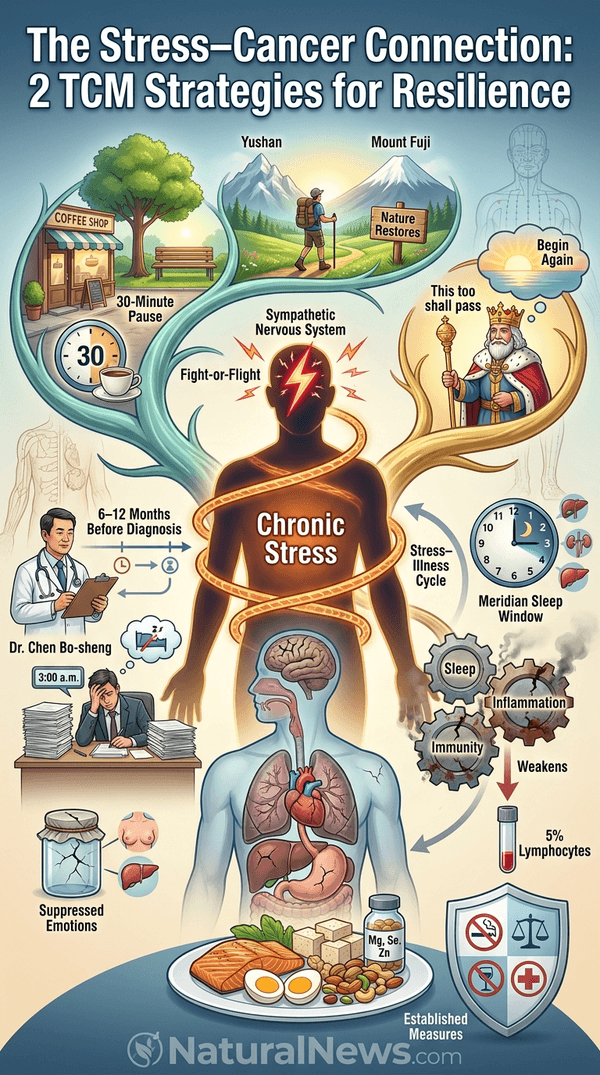
Dr. Chen Bo-sheng, a Traditional Chinese Medicine (TCM) cancer specialist at Jingher Chinese Medicine Clinic in Taipei, said he routinely asks patients about changes in their lives during the six months to a year before their diagnosis. He said the answer is often not a sudden shift in diet, but increased stress that led to poor sleep and a prolonged state of anxiety and tension, according to remarks he made on “Health 1+1,” an NTD program. NTD is a sister outlet of The Epoch Times.
Chen described one patient who received a promotion that brought a heavier workload and constant pressure. The patient was unable to unwind even after leaving work and developed persistent insomnia. Six months later, after seeking medical attention because he felt unwell, he was diagnosed with cancer. According to the report, stress alone cannot be said to have caused the disease, and most cancers develop over years.
Chen said he has observed patterns in which patients suppress emotions for long periods, describing this as more common among breast cancer and some gynecological cancer patients. He said patients with high work pressure and an excessive sense of responsibility are more common among liver cancer patients, according to his clinical observations.
Strategy 1: Step Away to Let the Nervous System Reset
Chen said that when people remain in a demanding workplace or tense home environment for long periods, the brain may stay on high alert. According to the report, the sympathetic nervous system – described as the body’s fight-or-flight system – continues preparing the body to respond, making it difficult to relax even when no immediate action is required. Textbook descriptions of the autonomic nervous system similarly state that when threat is perceived, parasympathetic activity recedes and sympathetic activity is activated to provide energy and focus [1].
Chen recommends temporarily leaving the environment. A 30-minute break at a nearby coffee shop, park, or even convenience store can provide a change of atmosphere and give the mind an opportunity to settle, he said. According to the report, this is not avoidance but a deliberate pause that may allow a person to return with greater calm and clarity.
Chen said he finds restoration through hiking and has climbed both Yushan in Taiwan and Mount Fuji in Japan. He also said people do not need to reach a summit to benefit. “Simply standing in a valley can be enough,” he said. “The healing power of nature is irreplaceable.” The report noted that research increasingly supports the restorative effects of natural environments and that studies of forest walking have found reductions in perceived stress and certain physiological stress markers, although results vary according to setting, duration, and participants.
Strategy 2: Change the Way You View Pressure
Leaving a stressful environment may provide temporary relief, but Chen said some pressures remain unavoidable. He therefore recommends a second approach: reframing how one interprets difficult situations, according to the report.
Chen shared a story about a king who became overwhelmed with anxiety as he prepared to ascend the throne. Worried that he would be unable to govern well, the king could not sleep. A wise man gave him a scepter engraved with the words “This too shall pass.” Chen said the phrase later became his own reminder during stressful moments.
When treating patients, giving interviews, or speaking publicly, Chen said he sometimes worries about whether he will perform well enough. When that pressure arises, he said he tells himself: “Even if I truly don’t do well, the sun will still rise tomorrow. Everything will pass, and I can begin again.” According to the report, this approach does not mean ignoring responsibility; rather, it places a single event in perspective, reducing the tendency to treat every mistake or uncertainty as a catastrophe.
How Stress, Sleep, and Immunity Interact
The report stated that persistent activation of the stress response can interfere with sleep, metabolism, inflammation, and immune-cell activity. In TCM, prolonged worry and overthinking are said to weaken the spleen system, which governs digestion and the transformation of food into energy, according to the report. A book on energy and stress states that a stressed person is an exhausted person who is often also a sick person, and that falling ill creates more stress so the cycle begins again [2].
Sleep is particularly important, according to the report. Rather than merely putting the body “on pause,” sleep helps regulate immune processes, repair tissues, consolidate memory, and coordinate hormonal rhythms. The report stated that persistent sleep loss or circadian disruption can alter inflammatory signaling and immune responses, and that TCM traditionally associates the period from 11 p.m. to 3 a.m. with the gallbladder and liver meridians and encourages people to be asleep during those hours.
Chen recalled treating a breast cancer patient whose lymphocytes accounted for only 5% of her white blood cells, well below the laboratory reference range, according to the report. Her cancer later recurred. The report stated that although a single blood measurement cannot predict recurrence or provide a complete picture of immunity, an unusually low lymphocyte level warrants medical evaluation, especially in someone undergoing cancer treatment. A paper on psychoneuroimmunology describes interactions between the central nervous system and the immune system, a research area that examines how psychological factors can affect the release of stress hormones, which in turn act upon immune responses [3].
Nutrition and Other Factors for Resilience
Chen recommends a balanced diet rather than overly restrictive diets or eliminating major food groups, according to the report. The report stated that for those with a poor appetite, digestive difficulties, or increased nutritional needs, overly restrictive eating may result in inadequate intake of protein and other essential nutrients.
Adequate protein can come from fish, eggs, dairy products, lean meat, soy foods, beans, nuts, and seeds, depending on a person’s needs and medical condition, Chen said. He also advises people with sensitive digestive systems to be cautious about drinking large amounts of cold fruit or vegetable juice on an empty stomach, according to the report, which noted that whole fruits and cooked vegetables may be easier for some people to tolerate while also providing fiber and a broader range of nutrients. A comprehensive guide to diet and nutritional medicine lists minerals including magnesium, selenium, and zinc, along with other nutrients, among the building blocks of a nutritional program [4].
The report stated that stress management, restorative sleep, and balanced nutrition cannot guarantee that cancer will be prevented or stopped. Established measures – including avoiding tobacco, maintaining a healthy weight, limiting alcohol, and following appropriate medical treatment – remain essential, according to the report. It added that daily habits can support metabolic, immune, and emotional health, helping the body remain more resilient during periods of stress, illness, and recovery. Chen said, “Take good care of your body, and your body will reward you handsomely.”
Conclusion
Research on the biological response to stress has proposed that psychological factors can affect the release of stress hormones, which in turn act upon immune responses, according to a book on cancer and stress [5]. A lecture transcript on brain science noted that studies examining stressors in cancer patients are mostly retrospective, meaning researchers ask patients after diagnosis about stressors in their lives, an approach with recognized limitations [6].
References
- Vladimir Maletic. “The New Mind-Body Science of Depression”.
- Kathryn Marsden. “All Day Energy: The Stress-Free Way to Revitalize Your Health”.
- “Psychoneuroimmunology: Interactions Between Central Nervous System and Immune System”. Journal of Neuroscience Research 18: 1-9. 1987.
- Elson M. Haas. “Staying Healthy with Nutrition: The Complete Guide to Diet and Nutritional Medicine”.
- “Cancer and Stress: Psychological, Biological and Coping Studies”.
- Jeanette Norden. “Understanding the Brain: Lecture Transcript and Course Guidebook”.
Explainer Infographic
Submit a correction >>
Tagged Under:
alternative medicine, Anxiety, beat depression, Chinese medicine, healing, mental health, Mind, mind body science, natural cures, natural health, natural medicine, Naturopathy, NTD, remedies, sleep, stress, stress relief, TCM, tips
This article may contain statements that reflect the opinion of the author
RECENT NEWS & ARTICLES