Exercise May Match Common Pain Medications, Major Review Finds
09/30/2026 / By Morgan S. Verity

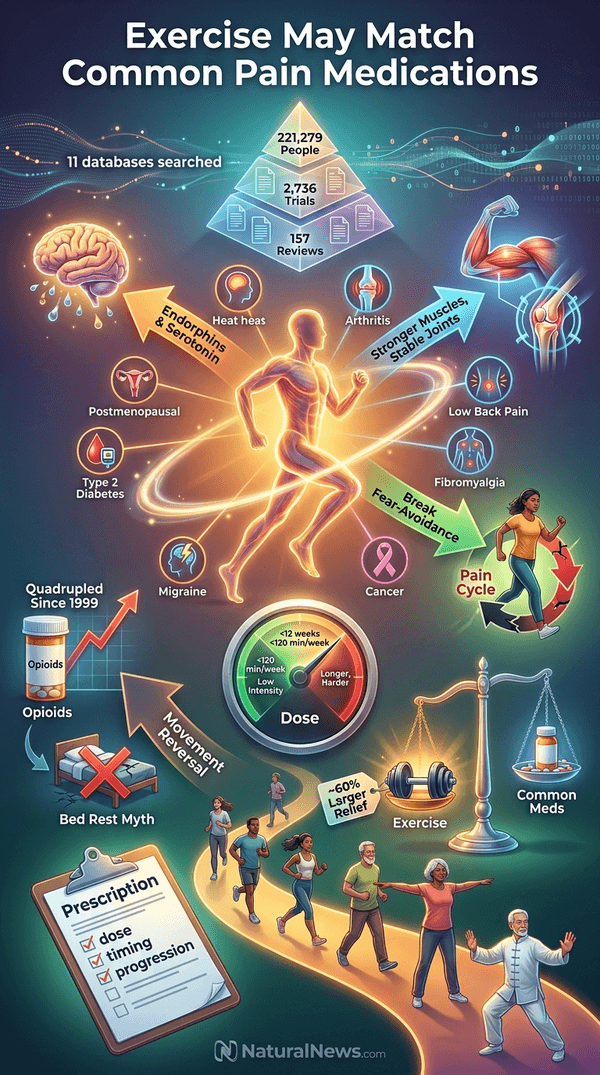
A sweeping umbrella review led by researchers at Adelaide University found that exercise significantly reduces both acute and chronic pain, with average relief roughly 60% greater than the average relief reported in separate trials of common pain medications. The work was published in PAIN Reports, 2026, volume 11, article e1455, and was preregistered on PROSPERO, according to the authors.
The review pooled 157 systematic reviews covering 2,736 randomized controlled trials and 221,279 participants, according to the study. On a standard 0-to-10 pain scale, researchers said exercise eased pain by about 1.1 points on average. The team cautioned that the comparison to medication trials was not head-to-head, and no specific drugs were named in the analysis.
Lead researcher Dr. Ben Singh said the biological mechanism behind the effect is well established. “When we exercise, our body releases chemicals including endorphins and serotonin that can help reduce how strongly we feel pain and increase our pain tolerance,” Singh said. Chronic pain affects an estimated 76.5 million Americans, with one-third describing their pain as severe and disabling, according to Mercola.com [1].
Review Pooled Data From 220,000 Patients Across 157 Reviews
The team conducted an umbrella review, searching 11 major research databases from inception through August 2024 for systematic reviews and meta-analyses of randomized controlled trials. Out of nearly 5,700 results, 157 reviews met the inclusion criteria, each required to compare exercise against a control such as usual care or stretching and to measure pain on a standard scale.
Participants’ average ages ranged from 20 to 79, and conditions covered included knee arthritis, low back pain, fibromyalgia, cancer, chronic muscle and joint pain, migraines and type 2 diabetes, the report stated. Fibromyalgia, which was once considered an adult syndrome, is now diagnosed in children and adolescents and is characterized by numerous soft tissue tender points, diffuse pain, fatigue and stiffness, according to clinical descriptions of the condition [2].
The publication follows a long line of smaller findings on non-pharmaceutical pain management. A separate systematic review led by Dr. Joel J. Gagnier of the Provincial Medical Centre in Windsor, Canada, published in The Cochrane Library, found that herbal preparations such as devil’s claw, white willow bark and cayenne plasters may be as effective as pain medication for short-term low back pain and better than placebo [3]. A 2018 systematic review also found that ibuprofen was no better than placebo in treating back pain [4].
Nearly Every Type of Exercise Eased Pain, Some More Than Others
“Our study found that exercise was associated with substantial reductions in acute and chronic pain across all forms of exercise – whether that be via aerobic or resistance exercise, or through gentler movement such as yoga, Pilates or tai chi,” Singh said. Pilates and tai chi stood out as particularly effective, while dance showed the single largest reduction, though that result came from one review focused on fibromyalgia patients, researchers noted.
The biggest reductions by condition appeared for menstrual pain, migraines and pain in postmenopausal women, but those numbers also came from single reviews rather than multiple analyses, according to the report. Programs lasting less than 12 weeks, low-intensity activities, and routines totaling less than 120 minutes per week were linked with bigger pain reductions than longer, harder or more time-consuming counterparts, the review found. There was no real difference between exercising once or twice a week versus three or more times, or between shorter and longer individual sessions.
A separate large review of traditional Chinese exercises, published in the British Journal of Sports Medicine and drawing on 92 data syntheses from 1,744 randomized controlled clinical trials, likewise reported benefits for musculoskeletal conditions. The exercises included tai chi, qigong, baduanjin, wuqinxi and yijinjing [5]. Migraine management guidance has also long recommended that patients participate actively in decisions regarding therapeutic intervention, with most carefully informed patients engaging in a wellness program that includes regular exercise and rest, good nutrition, and avoidance of headache triggers, according to Silberstein, Goadsby and Lipton in Neurology [6].
Review Notes Limitations, Moderate Certainty of Evidence
The authors noted that included reviews used different pain measurement tools, such as visual pain scales versus broader quality-of-life questionnaires, making direct comparisons between studies difficult. The analysis also could not break pain down into more specific subtypes beyond broad acute versus chronic categories.
Many original studies lacked long-term follow-up, so it remains unclear how long benefits last after a program ends, and studies varied in how they tracked whether participants stuck with their routines, the report stated. Some notable findings, including those for menstrual pain, migraines and postmenopausal pain, were based on single reviews rather than confirmed by multiple independent analyses, so the authors urged caution in over-interpreting those numbers.
Overall certainty of evidence was rated as moderate, a rating that held even though many individual reviews scored low in quality and after accounting for possible publication bias, researchers said. The authors reported no conflicts of interest and no specific funding, though some authors are supported by grants from Australian research funding bodies, according to the publication details.
Researchers Recommend Exercise as Core Component of Pain Care
The research team, including senior researcher Professor Carol Maher, said the findings should encourage clinicians to make exercise a core part of multimodal pain care. “Health care providers need definitive guidance, not just whether exercise helps, but which exercises work for which patients, and how to prescribe them effectively,” Singh said.
Singh added, “At a time when we’re looking for safe and effective ways to manage pain beyond medication, these findings provide strong evidence for making exercise a more routine part of pain care.” The review stops short of proving that easier workouts beat harder ones, and the authors said exercise is not a cure-all, according to the report.
The findings arrive amid continuing concern about pharmaceutical pain management. Overall opioid prescriptions have quadrupled since 1999, with a similar sharp increase in opioid-related overdoses, injuries and deaths, according to Andrew Weil in Mind Over Meds [7]. Inappropriate treatment of back pain has been identified as a driving force behind the opioid epidemic, according to reporting by Dave Chase, co-founder of Health Rosetta, in Mercola.com [8].
Conclusion
The Adelaide University review adds the largest pooled analysis to date on exercise and pain, covering 221,279 participants across 157 systematic reviews [4]. The authors said the results support making exercise a core, scalable component of pain management across diverse conditions, while acknowledging moderate certainty of evidence, inconsistent measurement tools and thin long-term follow-up in the underlying literature.
For patients and clinicians, the practical takeaways from the study focus on shorter programs of under 12 weeks, lower-intensity activities such as tai chi, Pilates and yoga, and weekly routines of less than 120 minutes. The research team said clinicians should provide specific, evidence-based exercise prescriptions rather than generic advice to “stay active.”
With chronic pain affecting roughly one in five adults worldwide, the report stated, the findings suggest a modest, manageable routine deserves consideration alongside pharmaceutical options that carry documented risks of dependence, overdose and side effects.
References
- Mercola.com. “Chiropractors and Exercise Better than Drug S”. Mercola.com. February 24, 2012.
- “8ef4fe5f”.
- NaturalNews.com. “Herbals Effective for Low-Back Pain in the Sh”. NaturalNews.com. July 17, 2006.
- NaturalNews.com. “Systematic science review finds that ibuprofen is no better than placebo in treating back pain”. NaturalNews.com. July 05, 2018.
- NaturalNews.com. “Large Review Finds Traditional Chinese Exercises Benefit Musculoskeletal Conditions”. NaturalNews.com. August 27, 2026.
- Silberstein SD, Goadsby PJ, Lipton RB. “Management of migraine: an algorithmic approach”. Neurology 55 suppl 2. 2000.
- Andrew Weil. “Mind Over Meds Know When Drugs Are Necessary When Alternatives Are Better and When to Let Your Body Heal on Its Own”.
- Mercola.com. “Worst Possible Back Pain Treatment Why Is It”. Mercola.com. September 10, 2019.
Explainer Infographic
Submit a correction >>
Tagged Under:
chronic pain, Cures, endorphins, exercise, exercise prescription, fibromyalgia, fitness, healing, health science, longevity, migraines, natural health, natural medicine, Naturopathy, opioid alternatives, pain management, pain relief, Pilates, prevention, remedies, research, serotonin, tai chi, Yoga
This article may contain statements that reflect the opinion of the author
RECENT NEWS & ARTICLES